Lyon is a city that reveals itself in layers. Walk through its streets and you will move from Roman amphitheatres to Renaissance courtyards, from silk-weaving workshops to contemporary museums. Few European cities offer such a continuous narrative of urban life, where the past is not locked away behind glass but forms the foundation of daily existence. For travellers who love history, Lyon is not a single destination but a collection of moments waiting to be uncovered.
The city’s geography shaped its destiny. At the meeting point of the Rhône and Saône rivers, Lyon became a natural crossroads for trade, ideas, and power. The Romans recognised this strategic value when they founded Lugdunum in 43 BC, making it the capital of the Gauls. That legacy of connection never faded, turning Lyon into a banking centre during the Renaissance and an industrial powerhouse in the nineteenth century.
What makes Lyon’s heritage so compelling is its human scale. You do not need a car or an elaborate itinerary to experience centuries of history in a single afternoon. The UNESCO-listed Old Town, the Croix-Rousse hillside, and the Presqu’île peninsula sit within walking distance of one another. Each neighbourhood tells a different story, from the prayers of silk workers to the ambitions of merchant bankers.
This guide brings together seventeen historic sites that capture the essence of Lyon. Some are world-famous landmarks, while others are quieter corners that reward the curious traveller. Together they form a portrait of a city that has always understood how to adapt without losing its soul. You will find Roman ruins, Gothic cathedrals, hidden passageways, and the birthplace of cinema.
As you plan your visit, remember that Lyon’s history is not just visual. It lives in the aroma of a bouchon kitchen, the echo of footsteps in a traboule, and the texture of silk in a weaver’s workshop. Engaging all your senses will give you a deeper appreciation of why this city has been named a World Heritage Site and why visitors return again and again.
Whether you have one day or one week, prioritising these historic sites will help you understand the forces that shaped Lyon. The following selection balances iconic monuments with lesser-known treasures, ensuring you experience the breadth of the city’s heritage rather than only its most photographed corners.
Basilica of Notre Dame of Fourvière

| Address | 8 Pl. de Fourvière, 69005 Lyon |
|---|
| Maps | Click here |
|---|
| Website | Click here |
|---|
| Opening Hours | Monday: 7:00 AM – 8:00 PM
Tuesday: 7:00 AM – 8:00 PM
Wednesday: 7:00 AM – 8:00 PM
Thursday: 7:00 AM – 8:00 PM
Friday: 7:00 AM – 8:00 PM
Saturday: 7:00 AM – 8:00 PM
Sunday: 7:00 AM – 9:00 PM |
|---|
| Phone | 04 78 25 13 01 |
|---|
Mohammad Diab★★★★★
I visited the Basilica of Notre Dame de Fourvière mainly to enjoy the panoramic view of Lyon from the top of the hill. Unfortunately, the basilica was closed at the time, so I didn’t get the chance to see it from inside.
However, the visit was still definitely worth it. The view over Lyon is beautiful and impressive, especially with the fresh air and the peaceful atmosphere at the top.
Taking the funicular up the hill was also a nice part of the experience. The journey is quite short, but it is different and enjoyable, and adds something special to the visit.
Even without going inside the basilica, I really enjoyed the experience. If you are visiting Lyon, I definitely recommend coming up here for the views and the overall atmosphere.
jose lourenco★★★★★
It’s important to note that walking around the basilica, its basement and the ‘chapel’ are free. You will need to pay for guided visit or to climb to the towers/roof. The basilica is very beautiful and ornate. Lots of Byzantine mosaics. They glimmer in the lights. Quite an impression. The window paintings make the cathedral shine as well.
Rosalie Wilder★★★★★
The Basilica of Notre-Dame de Fourvière took my breath away. It is absolutely stunning - the most beautiful basilica I have ever seen. Stepping inside felt like entering a dream. The atmosphere was so peaceful, despite the number of visitors. Every surface is covered in intricate mosaics, colorful stained glass, gilded details, and elaborate artwork. No matter where you look, there is something beautiful to admire. Photos simply cannot capture the scale, craftsmanship, and atmosphere of this incredible place.
We took the easy way up via the historic funicular, which was a fun experience for the kids and definitely saved our knees from the steep climb. The short ride up the hill is part of the experience and offers a unique way to reach one of Lyon’s most iconic landmarks.
Admission to the basilica is free, making it an easy addition to any Lyon itinerary. Once at the top, the panoramic views are spectacular. From the terrace, you can look out over Vieux Lyon, the winding Saône and Rhône rivers, the city skyline, and miles beyond. It’s also a short stroll to the ancient theatre. It’s the perfect place to pause, take photos, and appreciate just how beautiful Lyon is from above. It’s also a short stroll to the ancient theatre.
Paul Nash★★★★★
This is the most beautiful, ornate church I've ever been in (and frankly pales in comparison to Notre Dame de Paris which we visited on the previous day). The painted ceiling and huge mosaics on the walls and floor are just incredible. On this my second visit, we found the crypt, which is like a whole second church underneath the first one, and still quite impressive. Even the small side chapel is amazing. Leave yourself plenty of time toarvel at the art here.
Hashem Molavi★★★★☆
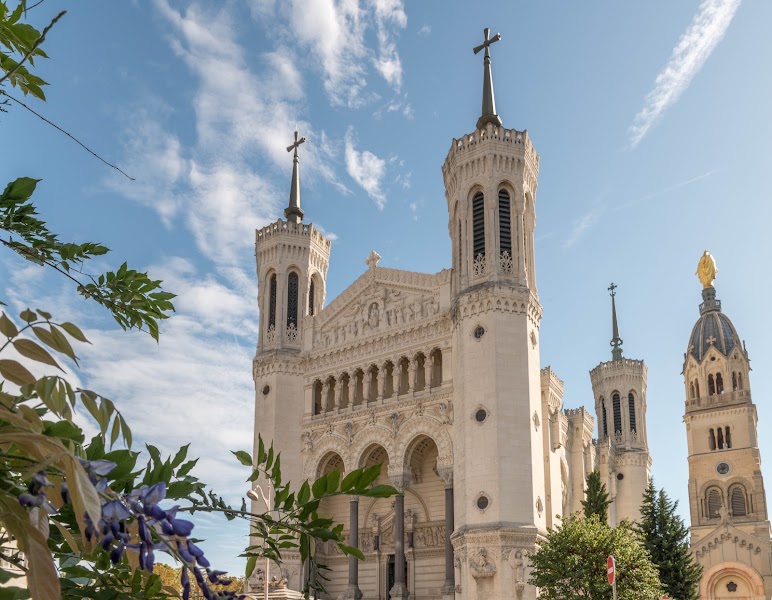
Basilique Notre-Dame de Fourvière is a major landmark in Lyon located on Fourvière Hill, offering one of the best panoramic viewpoints over the city. It is a Roman Catholic basilica known for its distinctive architectural style, combining Byzantine and Romanesque influences, with highly detailed mosaics and interior decoration.
The site is accessible via funicular from Vieux Lyon or by walking uphill, and the journey itself adds to the overall experience. The basilica is well-maintained, and the surrounding esplanade provides expansive views over the Saône and Rhône rivers, as well as key city landmarks.
Inside, the structure is richly decorated with mosaics, stained glass, and ornate detailing, making it significantly more elaborate than typical churches in France. It is both a religious site and a major tourist attraction.
Overall, the basilica is one of Lyon’s most iconic points of interest, combining architectural significance with exceptional city views.
Cathédrale Saint-Jean-Baptiste

| Address | Pl. Saint-Jean, 69005 Lyon |
|---|
| Maps | Click here |
|---|
| Website | Click here |
|---|
| Opening Hours | Monday: 2:00 – 7:00 PM
Tuesday: 8:30 AM – 7:00 PM
Wednesday: 8:30 AM – 7:00 PM
Thursday: 8:30 AM – 7:00 PM
Friday: 8:30 AM – 7:00 PM
Saturday: 8:30 AM – 7:30 PM
Sunday: 8:00 AM – 7:30 PM |
|---|
| Phone | — |
|---|
Rosalie Wilder★★★★☆
I stumbled upon the Cathedral of Saint John the Baptist while wandering through Vieux Lyon, and it was a pleasant surprise. The cathedral is beautiful, with impressive architecture and a peaceful atmosphere. It was an easy stop to make, and best of all, there were no crowds during my visit, which made it easy to take in the details and enjoy a quiet moment away from the busy streets of the Old Town.
Hashem Molavi★★★★☆
Cathédrale Saint-Jean-Baptiste is a historic Gothic cathedral located in Vieux Lyon, serving as the city’s primary religious landmark and the seat of the Archbishop of Lyon. It is also known as the Primatiale Saint-Jean-Baptiste, reflecting its long-standing ecclesiastical importance in France.
The cathedral was constructed between the 12th and 15th centuries, featuring a classic Gothic façade with a large rose window, intricate stonework, and a richly detailed interior. One of its most notable highlights is the astronomical clock, a medieval mechanical masterpiece that still operates today.
Located in a UNESCO-listed old town, the cathedral is easily accessible and surrounded by narrow medieval streets, cafes, and historical architecture. Its position makes it a central point when exploring Vieux Lyon.
Overall, it is one of the most significant religious and architectural monuments in Lyon, combining historical depth with strong visual and cultural presence.
Boris Moris★★★★★
Beautiful cathedral to visit, especially during the day when the sunlight shines through the stained glass windows and creates a stunning pink glow throughout the interior. Highly recommend stopping in to explore and walk around the surrounding area as well.
Mike Z★★★★★
Magnificent structure located at the base of Fourviere hill is filled with centuries religious and architectural history. Due to about 300 years of construction, it is a mix of Romanesque and Gothic styles. One of the most famous features of the cathedral is Astronomical clock. Must see in the old town part of Lyon.
Jay Patel★★★☆☆
Impressive on the outside and outside. The views of Lyon alone are worth the trek but the interior of the cathedral really sets this apart.
Special mention to the Astrological Clock.
Traboules du Vieux Lyon

| Address | 27 Rue Saint-Jean, 69005 Lyon |
|---|
| Maps | Click here |
|---|
| Website | Click here |
|---|
| Opening Hours | Monday: Open 24 hours
Tuesday: Open 24 hours
Wednesday: Open 24 hours
Thursday: Open 24 hours
Friday: Open 24 hours
Saturday: Open 24 hours
Sunday: Open 24 hours |
|---|
| Phone | — |
|---|
Rosalie Wilder★★★★☆
The traboules are an interesting piece of history and can feel like a hidden adventure when you manage to find one. Walking through the passageways gave me a sense of discovering something off the beaten path, and I enjoyed that aspect of the experience.
However, finding the traboules was much more difficult than I expected. My best advice is to keep an eye out for the lion head signs, as they were often the only clue that I was in the right place. Even then, there was very little signage or guidance, and many entrances looked no different from ordinary, somewhat neglected alleyways. I frequently found myself wondering whether I had actually found a traboule or was simply wandering through a back passage. To make things more challenging, most of the traboules have become private and are no longer accessible to the public. Unless you have a reliable app or guide that identifies the ones still open, be prepared to spend quite a bit of time searching, often without much success.
Even when following a map, some passageways were unexpectedly closed without explanation. The open passages were often dimly lit, narrow, and dirty, which made them feel somewhat uncomfortable to navigate. While the traboules themselves are fascinating from a historical perspective, the overall experience was underwhelming due to the lack of accessibility, poor directions, and frequent closures.
Emre Ersoy★★★★☆
Nothing special for me. History of the buildings was nice and it is crucial to understand the architecture but thats all. Like you are looking at the different stairwells
Loo Yeo★★★★★
A short public crossing that gathers much of Vieux Lyon’s interior architecture into a few metres. Google Review limited.
Ed Tom★★★★★
So beautiful ! It is not crowded like Paris but has all the charm.. very easy to get around especially for first time tourist… easily to get around within 15 minutes everywhere.. so many Michilin star restaurant as well as local favorite eatery!!!
Wendy Leung★★★★★
Grab a map from the tourism office and explore the historic passages in the old town in Lyon. It can get crowded especially in the morning with other tour groups.
Palais de la Bourse de Lyon

| Address | Pl. de la Bourse, 69002 Lyon |
|---|
| Maps | Click here |
|---|
| Website | Click here |
|---|
| Opening Hours | — |
|---|
| Phone | 04 72 40 58 79 |
|---|
Loo Yeo★★★★★
Today’s rue de la République was cut through old central Lyon in the 1850s, then known as rue Impériale, to create a broad new axis across the Presqu’île. At the Cordeliers, the Palais de la Bourse gave that corridor its monumental commercial centre. Inside were the Chamber of Commerce, the commercial court, the prud’hommes, brokers, shops and the exchange hall, concentrating trade, judgement and civic authority in one address. Napoleon III inaugurated the palace in 1860 after passing along the new street, turning it into an official emblem of the transformed city. From the square, the façade still reads as the signature of that remaking: a prestigious centre produced through expropriation, demolition and a new urban order built to channel movement, power and commerce.
Wisanu Tuntawiroon★★★★★
The Palais de la Bourse, also known as the Palais du Commerce, is one of Lyon’s most elegant 19th-century landmarks. Located on Rue de la République, right in the heart of the Presqu’île, this grand building was originally constructed to house Lyon’s Chamber of Commerce and reflects the city’s rich history of trade, silk, and finance.
Its architecture is a beautiful example of Second Empire style, with a stately façade, arched windows, and finely detailed stonework that hint at the city’s prosperous past. Inside—when open for events or guided tours—you’ll find impressive halls, including the spectacular Salle de la Corbeille, with high ceilings, chandeliers, and ornate décor that speaks to the ambition and elegance of 19th-century Lyon.
Carol Keiter★★★★★
I went on a Sunday evening, booked in advance, made me think about the beginning of life on earth and then the matter that man has made. Loved the sound effects of being submerged in water and the bubbles.
Mike Z★★★★★
Majestic landmark with facades richly decorated with sculptures representing city’s strengths, was an official home of Lyon Stock Exchange. Building’s architecture was intended to project stability and wealth to reassure investors.
Kent Wang★★★★★
Palais de la Bourse was completed in 1862 by architect René Dardel in the Second Empire style, with classical proportions, elaborate sculptural decoration, and a monumental façade. The exterior is adorned with allegorical figures representing commerce, industry, and navigation—symbols of Lyon’s economic identity during the 19th century.
Traboule et Cour des Voraces

| Address | 9 Pl. Colbert, 69001 Lyon |
|---|
| Maps | Click here |
|---|
| Website | Click here |
|---|
| Opening Hours | — |
|---|
| Phone | 04 72 10 30 30 |
|---|
Rosalie Wilder★★★★☆
One of our favorite discoveries in Lyon was this hidden traboule featuring a spectacular six-story staircase once used by the city’s silk workers in the 19th century. Tucked away from the busy streets, finding it felt like uncovering a secret passage through history. We loved wandering through the passageways, admiring the intricate stonework, and imagining what life was like for the workers who used these stairs centuries ago. It was a fun little family adventure and a unique way to experience Lyon’s rich architectural and cultural heritage.
What made the experience a bit bittersweet was seeing signs of neglect in some areas. A place with so much history deserves better care, yet we encountered garbage, graffiti, and strong urine odors along parts of the route. Even so, the traboule’s fascinating history and unique character made it a memorable stop and a glimpse into a hidden side of Lyon that many visitors might otherwise miss.
Ribeye★★★★★
Visiting Traboule et Cour des Voraces was a captivating experience. Hidden away in Lyon, this architectural gem left me in awe. The spectacular design features a historic six-story staircase used by silk workers in the 19th century. Its unique, hidden nature adds to the charm, making it feel like a secret passage through history.
The intricate stonework and historical significance make it a fascinating spot to explore and appreciate Lyon's architectural heritage.
Cristian Contreras★★★★★
I had an incredible experience in a residential building featuring stunning brutalist architecture in the heart of Lyon. The unique design and striking aesthetic made the visit truly memorable. It was a fantastic blend of urban living and architectural brilliance that I thoroughly enjoyed.
AperolSpritz J★★★★★
The north entrance is a little green space. See my photos. Once you walk in, you’ll see the traboule right away. There’s an elevator that takes you to the top so you don’t have to actually climb the stairs.
Judhajit Basak★★★☆☆
It was good experience but something that is going to blow my mind. All in all mid.
Gallo-Roman Museum of Lyon-Fourvière

| Address | 17 Rue Cleberg, 69005 Lyon |
|---|
| Maps | Click here |
|---|
| Website | Click here |
|---|
| Opening Hours | Monday: Closed
Tuesday: 11:00 AM – 6:00 PM
Wednesday: 11:00 AM – 6:00 PM
Thursday: 11:00 AM – 6:00 PM
Friday: 11:00 AM – 6:00 PM
Saturday: 10:00 AM – 6:00 PM
Sunday: 10:00 AM – 6:00 PM |
|---|
| Phone | 04 72 38 49 30 |
|---|
Loo Yeo★★★★★
LUGDUNUM - Musée & Théâtres romains turns Lyon’s Roman hillside into a layered reading of name, site, objects, and architecture. “Lugdunum” combines a Gaulish divine name, usually linked with Lugus, and dūnon, a Celtic term for a fortified height; it remained the formal Latin name for centuries before medieval “Lyon” took over. The museum itself was long imagined before Bernard Zehrfuss was commissioned in 1966. Built into Fourvière’s slope and opened in 1975, it keeps the theatre and odeon visually dominant while using raw concrete, a broad spiral ramp, and deep daylight shafts to reconnect the collections with the ruins outside. Beyond the auditoria, roads, cisterns, shop units, hypocaust remains, and reclassified structures show a Roman quarter that was practical, commercial, and complex.
Steven Damalas★★★★★
This marvelously laid out museum brings the Roman Theatre site to life for visitors. Though the museum is remarkably unattractive from the outside, the interior design is ingenious and quite inviting to the visitor. Great explanatory signage is provided, and there is enough space to properly exhibit the huge number of sometimes massive objects. Cudos to the designers and curators of this museum!
Rob Tulloh★★★★☆
The museum has a nice selection of artifacts. They also are one of the few places that offer seniors free admission. Admission was 7 euros for adults. You start at the top and work your way down chronologically experiencing the artifacts and history of the city. I recommend you store items on the lockers at the entrance. You can return by elevator once you reach the bottom of the museum.
Laura Carolina★★★★★
Excellent exhibition in a fabulous building, built into the hillside. Visitors flow easily, gradually downward. (Even if you’re not interested in the subject matter, the building design is worth seeing!) Many, but not all, signs provide English as well as French. Two large windows overlook the theatre ruins outside. There are even some comfortable chairs to rest in along the way. There are some interactive displays and a children’s area. It’s the museum’s 50th anniversary. A very well done museum.
Juliana Henriques★★★★★
This museum was simply the best surprise of our stay in Lyon. The curating and organization were well done, and the way each piece is displayed is incredible. We loved the experience the museum offered!
Odeon of Lyon

| Address | 17 Rue Cleberg, 69005 Lyon |
|---|
| Maps | Click here |
|---|
| Website | Click here |
|---|
| Opening Hours | Monday: 7:00 AM – 7:00 PM
Tuesday: 7:00 AM – 7:00 PM
Wednesday: 7:00 AM – 7:00 PM
Thursday: 7:00 AM – 7:00 PM
Friday: 7:00 AM – 7:00 PM
Saturday: 7:00 AM – 7:00 PM
Sunday: 7:00 AM – 7:00 PM |
|---|
| Phone | 04 72 77 34 65 |
|---|
Loo Yeo★★★★★
The Odéon antique de Lyon was small only by comparison: about 73 metres across, with seating for up to around 3,000. In Roman Gaul, this kind of purpose-built listening room was uncommon, and its presence signalled Lugdunum’s cultural rank. Its programme was closer to voice than spectacle: concerts, declamations, lectures and civic meetings, held in a tighter architectural envelope. A massive rear wall, more than six metres thick, is read as support for a roof, making the auditorium more enclosed and acoustically controlled. Two tiers of seats stepped down to an orchestra paved like imperial marquetry, with porphyry, granite and marble from Greece, Egypt, Africa and Asia Minor. The later monument also inherited an already prepared Augustan terrace.
JooZoo WG★★★★★
Was there early, lesser crowds. More crowds flooded the place around 11am onwards. The place was beautiful.
You can walk up a slope for 30mins from the city centre or take the public transport.
jose lourenco★★★★★
This must have been quite impressive when it was in full form. Today only the foundations are preserved. The existing bleachers were rebuilt on part of it.
Catalin Hulea★★★★★
A place that tourists don’t really flock to, and I don’t understand why.
I left behind the incredible crowds around the famous Basilica of Notre-Dame de Fourvière and, just a few hundred meters away, I discovered the ruins of the Roman city of Lugdunum. Most reviews focus on the Roman theatre, the Odeon, the thermae, etc., but in reality the archaeological complex is much larger - we are talking about an entire city.
The place is truly spectacular; you simply can’t help but be impressed by the sheer scale of the buildings, some of which are very well-preserved (the ancient theatre, for example).
As additional points of interest: admission is free, the site is shaded and very pleasant for a walk (perhaps even for a picnic) and the view rivals that of the famous Esplanade de Notre-Dame de Fourvière.
PS: For those interested in history, two Roman emperors (Claudius and Caracalla) were born in this city.
Nathalie C★★★★★
If you're visiting the Fourvière Cathedral in Lyon, I highly recommend taking a short 5-minute walk to the Odéon de Lyon. One of the best parts about this ancient Roman theatre is that you don’t need to buy a ticket to explore it. Also, it is a serene place where you can take in the beauty of the ancient architecture and imagine what life was like in Roman times.
Théâtre Gallo Romain

| Address | 17 Rue Cleberg, 69005 Lyon |
|---|
| Maps | Click here |
|---|
| Website | Click here |
|---|
| Opening Hours | Monday: Closed
Tuesday: 11:00 AM – 6:00 PM
Wednesday: 11:00 AM – 6:00 PM
Thursday: 11:00 AM – 6:00 PM
Friday: 11:00 AM – 6:00 PM
Saturday: 10:00 AM – 6:00 PM
Sunday: 10:00 AM – 6:00 PM |
|---|
| Phone | 04 72 38 49 30 |
|---|
David P★★★★★
Such a beautiful area, with the ruins of a Roman amphitheater that have been remarkably well preserved. It was amazing to see that the site still appears to be used for concerts and performances. When we visited, they were setting up audio equipment for what was presumably a show later that evening. The area is free to walk around.
How incredible would it be to attend a performance in a venue that has been entertaining people for nearly two thousand years?
Rob Tulloh★★★☆☆
Interesting spot but too much of it has modern adaption which kind of spoils the experience. There are nice spots to take pictures of the city below. The adjacent museum has a nice selection of artifacts.
Hashem Molavi★★★★☆
Roman Theatre of Fourvière is an ancient Roman amphitheatre located on Fourvière Hill in Lyon, adjacent to the modern city’s historic core. It is part of the archaeological site of Lugdunum, which preserves significant remnants of Roman-era urban life.
The theatre dates back to the 1st century AD and was used for performances, public gatherings, and cultural events. Today, it remains remarkably well-preserved and is still actively used during the annual Nuits de Fourvière festival, hosting concerts, theatre, and cultural performances.
The site is open to visitors and offers free access to much of the ruins, allowing close exploration of the stone seating areas and stage structure. Its elevated position also provides panoramic views over Lyon.
Overall, it is one of the most important historical landmarks in the city, combining archaeological value with ongoing cultural use.
Rosalie Wilder★★★★☆
Just a short walk from the Basilica of Notre-Dame de Fourvière, this remarkably preserved Roman theater is well worth a visit. Be prepared for some steep steps, but the effort is rewarded with stunning views over Lyon. Find a seat in the ancient amphitheater, soak in the atmosphere, and enjoy one of the city’s most beautiful sunset spots.
Alice P★★★★★
It’s free to enter the theatre part and it’s open 24x7.
At night it lights up and it looks a lot more impressive than during daytime.
The most impressive part was the original road that was more than 2000 years old that you get to walk on.
Not suitable for disabled people with wheelchair.
Elderly people needs to be careful as the rocky paving Road is very uneven to walk on.
The future of the city is very impressive
Place Bellecour

| Address | Pl. Bellecour, 69002 Lyon |
|---|
| Maps | Click here |
|---|
| Website | Click here |
|---|
| Opening Hours | Monday: Open 24 hours
Tuesday: Open 24 hours
Wednesday: Open 24 hours
Thursday: Open 24 hours
Friday: Open 24 hours
Saturday: Open 24 hours
Sunday: Open 24 hours |
|---|
| Phone | 04 72 77 69 69 |
|---|
V ____★★★★★
Place Bellecour is a great spot in the center of Lyon. It’s a beautiful square and a very convenient place to walk through, relax, or attend events. I was there during a French national holiday, and there was plenty of space, with benches and a very well-organized setup.
It’s also one of those places that feels both lively and open at the same time, which makes it especially enjoyable. A very nice place in the heart of the city.
Hashem Molavi★★★★☆
Place Bellecour is one of the largest open squares in Europe and a central landmark in Lyon. Its expansive layout offers unobstructed views and serves as a key urban hub connecting major shopping streets, cultural sites, and public transport lines.
The square is well-maintained, with wide pedestrian areas that make it ideal for walking, meeting, or simply passing through the city center. A notable feature is the statue of Louis XIV, which adds historical significance to the space.
Accessibility is excellent, with direct connections to metro and bus networks, making it a convenient starting point for exploring Lyon. While the square itself is relatively minimal in terms of shade and seating, its central location compensates with easy access to nearby cafes, shops, and attractions.
Overall, Place Bellecour functions more as a strategic urban space than a leisure park, offering strong connectivity and a sense of scale that reflects the city’s structure.
Mike Z★★★★☆
Large city square that could really benefit from more trees, but there are practical obstacles for city implement it: just below the surface there is a massive underground garage and 2 lines of Metro, so no space for tree roots… Another reason is that historically the square was an open parade grounds. The attempt to solve the problem by installing colorful masts and arches looks somewhat weird on historic square.
Abhishek Maji★★★★★
Place Bellecour is one of those places that instantly makes you feel the scale and spirit of Lyon. The square is large and open, giving you a rare sense of space right in the middle of the city.
The view of the Basilica of Notre-Dame de Fourvière in the distance adds a beautiful backdrop, especially around sunset when the light softens the entire square. There’s often a relaxed atmosphere here—people walking, sitting, or just enjoying the surroundings—without it ever feeling too crowded or overwhelming.
Loo Yeo★★★★★
Place Bellecour was never only a promenade for the addresses around it. The façades and open sweep suited display, and the good society used it that way, but the square also lay across the city’s daily routes. To live south and go north for trade, administration, school, worship, or sociability meant crossing the same exposed ground, so prestige and passage were bound together from early on. Later access widened that mix further, bringing in people who did not live on its edges but used it as Lyon’s common threshold. That is why Bellecour still feels unsettled in a productive way. It has to carry ceremony, shortcuts, waiting, events, and rest on the same hard, heat-prone surface, and every attempt to cool or soften it also asks how a shared square should be lived.
Place des Terreaux

| Address | Pl. des Terreaux, 69001 Lyon |
|---|
| Maps | Click here |
|---|
| Website | Click here |
|---|
| Opening Hours | Monday: Open 24 hours
Tuesday: Open 24 hours
Wednesday: Open 24 hours
Thursday: Open 24 hours
Friday: Open 24 hours
Saturday: Open 24 hours
Sunday: Open 24 hours |
|---|
| Phone | 04 72 98 54 04 |
|---|
Wally Turnbull★★★★★
Place des Terreaux is one of Lyon’s two most beautiful and vibrant public squares, rivaled only by Place des Jacobins. Nestled at the foot of the Croix-Rousse hill, this historic plaza has witnessed centuries of Lyon’s history. Its name, terreaux (“ditches” or “moats”), recalls the medieval defensive works that once protected the city. During the French Revolution, the square took on a darker role as the site of public executions by guillotine.
Today, Place des Terreaux is framed by two of Lyon’s most impressive landmarks: the magnificent Hôtel de Ville (City Hall), with its grand Baroque façade, and the Musée des Beaux-Arts de Lyon, housed in a former 17th-century Benedictine convent. The museum is often considered one of France’s finest art museums outside Paris, and both buildings provide outstanding opportunities for photography.
At the center of the square stands the dramatic Bartholdi Fountain, created by Frédéric-Auguste Bartholdi, the sculptor best known for designing the Statue of Liberty. The fountain depicts France as a chariot pulled by four powerful horses representing the country’s major rivers. Originally commissioned for Bordeaux, it was ultimately installed in Lyon, giving it a fascinating story to match its striking appearance.
The square itself was redesigned in the 1990s by artist Daniel Buren and architect Christian Drevet, who transformed the open space into an interactive urban landscape. Embedded fountains and water jets emerge unexpectedly from the pavement, delighting children and adults alike. After dark, subtle lighting effects create a magical atmosphere, turning the plaza into both a visual spectacle and a playful gathering place.
Whether you are interested in history, architecture, art, or simply soaking up the local atmosphere, Place des Terreaux is one of Lyon’s essential destinations. It is the perfect place to pause over a coffee, enjoy a meal or gelato, watch the city go by, and experience the lively spirit that makes Lyon one of France’s most captivating cities.
Mike Z★★★★★
In 16th century the the place undergone the transformation from muddy ditch to large unpaved market square as a result of city’s northward expansion and construction of Hotel de Ville. Benedictine convent rebuilt as a grand palace is now Museum of Fine Arts. Finally, in 1892 the square received its crown jewel: Bartholdi Fountain. Today the Place des Terreaux is vibrant pedestrian hub, and the most memorable landmark in Lyon for me.
Mariana Nahirna★★★★★
A wonderful place for a walk. It has the feel of French streets. Atmospheric Lyon.
Wisanu Tuntawiroon★★★★★
Place des Terreaux is one of Lyon’s most vibrant and historically rich squares, nestled between the Hôtel de Ville (City Hall) and the Musée des Beaux-Arts. With its lively atmosphere, striking architecture, and cultural significance, it’s a natural gathering spot and a favorite among both locals and visitors.
At the heart of the square stands the dramatic Bartholdi Fountain, a masterpiece of bronze sculpture featuring a chariot pulled by four wild horses—designed by the same artist who created the Statue of Liberty. The fountain alone is worth the visit, offering a powerful sense of movement and expression.
Kari Q.★★★★★
Beautiful square featuring Lyon City Hall, Bartholdi Fountain, restaurants, sweet shops, and bars. Also la Mie Caline, where you can get an awesome double espresso for 2€50. A must visit, highly recommend 🇨🇦
Hôtel-Dieu de Lyon

| Address | 1 Pl. de l'Hôpital, 69002 Lyon |
|---|
| Maps | Click here |
|---|
| Website | Click here |
|---|
| Opening Hours | Monday: 7:30 AM – 1:00 AM
Tuesday: 7:30 AM – 1:00 AM
Wednesday: 7:30 AM – 1:00 AM
Thursday: 7:30 AM – 1:00 AM
Friday: 7:30 AM – 1:00 AM
Saturday: 7:30 AM – 1:00 AM
Sunday: 7:30 AM – 1:00 AM |
|---|
| Phone | — |
|---|
Loo Yeo★★★★★
Grand Hôtel-Dieu began as a refuge beside the Rhône bridge, receiving poor travellers, pilgrims and the sick before becoming Lyon’s civic hospital in the late fifteenth century. Across the centuries, that duty took architectural form: seventeenth-century hospital ranges and chapel, then Soufflot’s long eighteenth-century Rhône façade and Grand Dome, turning care into one of the city’s most visible public buildings. Its economy was never only charitable; rents, property and shops helped sustain the institution alongside donations and civic support. Clinical use ended in 2010, and the complex now carries a different life through restored courtyards, hospitality, shops and heritage circulation. The building still holds the old sequence clearly: care, city, architecture, income and reuse.
Wendy Leung★★★★★
It was once a hospital but now transformed to high end retail shopping with Intercontinental hotel in one end. The restaurant on the top floor boasts the most beautiful for the view of the city. It has a lovely courtyard.
Udi Miller★★★★★
It is absolutely remarkable to see this hugh restoration and transformation of this exceptional monument . It maked such surprise see the quality of the works done . The part of the luxury Hotel Intercontinental is highly appreciated . I regret not having ever before visited this place. Most recommanded to all of public, visitirs and tourists .
Cansu Kurt Green★★★★★
We were not guests at the hotel, but as it is an impressive building we popped in to see it and was certainly worth it. Bar Dome is stunning and everyone is welcome. Definitely recommend a quick visit.
cathy wang★★★★☆
The hotel location is great. But I maynot choose this hotel next time in Lyon with his price. This building was build in 12 century. It was used for hospital for many years. Burned and rebuilt. You could walk in the first floor to experience the culture, without pay the entry fee. Also, they converted a part of building as many shops. It is like a hotel combine with shops and restaurants.
What I am not appreciated it during my stay, I was charged €4 for a set of plate and tableware.
Once you paid over $300 per night, I should not care €4 charges, but it is a principle.
I remembered I was charged for a kettle of hot water in LAs in 2001 last time. But that hotel was $100 a night. And it is not a chain hotel. And I was not a platinum member either.
Jardin Archéologique

| Address | 5 Rue des Estrées, 69005 Lyon |
|---|
| Maps | Click here |
|---|
| Website | Click here |
|---|
| Opening Hours | Monday: Open 24 hours
Tuesday: Open 24 hours
Wednesday: Open 24 hours
Thursday: Open 24 hours
Friday: Open 24 hours
Saturday: Open 24 hours
Sunday: Open 24 hours |
|---|
| Phone | 04 72 77 69 69 |
|---|
Loo Yeo★★★★★
When a planned courthouse extension opened the ground north of Saint-Jean Cathedral, it exposed the buried layout of Lyon’s first Christian centre. Excavations from 1972 to 1977 uncovered a tight episcopal complex arranged near the Saône: Saint-Jean for the bishop’s liturgy and councils, Saint-Étienne growing from the baptistery and episcopal font, and Sainte-Croix serving the surrounding parish. The city bought the land and turned it into an open-air archaeological garden, later classified as a Monument historique. Today the rectangular, terraced plot keeps the ruins in situ. Paths and panels help pick out the baptistery’s circular trace, Sainte-Croix’s apse fragments, a freestanding arch and low wall lines in the grass, turning scattered masonry into a readable map of early Christian Lyon.
Catalin Hulea★★☆☆☆
There is almost nothing left to see here—just a few fragments of the old walls and part of a portal.
In fact, most of the photos you find online are not of the archaeological site itself, but of nearby tourist attractions.
There is no point in planning a specific route to visit this place. If you wander through the streets of Vieux Lyon, you will come across it anyway.
Anne Chen★★★★☆
🌳 Special small park in downtown Lyon 🏙️🌳
In downtown Lyon, a park so dear, 🌳🏙️
Where tranquility reigns, crystal clear. 🌿
Remnants of a cathedral, from the past, ⛪️🏰
Whispers of history that forever last. 📜🌟
A view of Notre Dame, atop the hill, 🌅⛪️
A sight that fills the heart, a thrill. 🌆💖
For locals, a haven to stroll and play, 🚶♂️🎶
Where laughter and dance color the day. 💃🎵
Tourists too, find joy in this place, 🌳🚶♀️
A moment of respite, a smile on their face. 😊🌅
🌟AJ suggests to park🌟
Grow more flowers 🌺🌼🌻
Tim Wall★★★★☆
A quick visit is worth it, especially since it's so close to other sites. Amazing to think of all the history behind that spot.
Tina★★★★☆
Nice place to visit!
Fresque des Lyonnais

| Address | 2 Rue de la Martinière, 69001 Lyon |
|---|
| Maps | Click here |
|---|
| Website | Click here |
|---|
| Opening Hours | Monday: Open 24 hours
Tuesday: Open 24 hours
Wednesday: Open 24 hours
Thursday: Open 24 hours
Friday: Open 24 hours
Saturday: Open 24 hours
Sunday: Open 24 hours |
|---|
| Phone | — |
|---|
Loo Yeo★★★★★
Created by Lyon muralists CitéCréation in 1994/95, the Fresque des Lyonnais turns an 800-square-metre blind wall at Quai Saint-Vincent and Rue de la Martinière into a trompe-l’œil building inhabited by the city’s history. Figures appear at painted windows, doors and balconies, arranged in a vertical order rather than scattered across the façade: the lower levels stay close to the present-day street, while older figures rise through the upper floors. Around 250 proposed names passed through learned, historical and heritage circles before 24 historical Lyonnais figures were chosen. The result places saints, scientists, writers, filmmakers, inventors, cooks and popular figures into everyday view, making civic memory public, readable and distinctly tied to Lyon’s mural tradition.
Judhajit Basak★★★★☆
Beautiful place to walk out to sit and enjoy a coffee. Great recreational space and very peaceful in the bustling hear of the city.
JooZoo WG★★★☆☆
Erm. Will not say fantastic. No need to come just for this unless you have time or feeling to fill the gap of your time.
Nonetheless, looks nice, just that the graffiti below don’t look good on this building.
Patrik Vagner★★★★★
A very beautiful, quite real feeling that those personalities are standing there. Even the impression that you can walk inside, hahaha. I definitely recommend it for watching.
Patrizia Iginia Palazzini★★★★★
The Fresques des Lyonnais in Lyon, is absolutely stunning!
These murals bring the streets of Lyon to life with incredible detail and color, showcasing the city’s history and culture in a vibrant way.
Walking along the streets and discovering these paintings feels like exploring an open-air museum. The artwork is lively, creative, and truly impressive—each mural tells its own story.
A must-see for anyone visiting Lyon who loves art, culture, and a little surprise around every corner!
Bartholdi Fountain

| Address | Pl. des Terreaux, 69001 Lyon |
|---|
| Maps | Click here |
|---|
| Website | Click here |
|---|
| Opening Hours | Monday: Open 24 hours
Tuesday: Open 24 hours
Wednesday: Open 24 hours
Thursday: Open 24 hours
Friday: Open 24 hours
Saturday: Open 24 hours
Sunday: Open 24 hours |
|---|
| Phone | 04 72 77 69 69 |
|---|
Dusty Trails★★★★★
Great metal fountain. Pro tip hit a bakery and sit on the stairs to the side of the courtyard early in the morning and watch the city wake up. During the day it's busy and care should be taken.
Loo Yeo★★★★★
Bartholdi’s fountain began as Bordeaux’s unrealised civic ambition. In 1857 the city opened a competition for a Quinconces fountain featuring the Garonne; Bartholdi won in January 1858, but the scheme was never carried through. Revived, enlarged and again abandoned as too costly, it finally appeared in 1888 through Gaget & Gauthier, then filled the Galerie des Machines at the 1889 Exposition Universelle under its original name, Char triomphal de la Garonne. Lyonnais visitors admired it, pressed Mayor Antoine Gailleton to acquire it, and in 1890 Lyon bought it for 100,000 francs. Place des Terreaux came only after municipal site testing. The result still holds that improbable passage: a 21-tonne surge of horses, spray and command, hammered from lead only 1-4 mm thick.
Patrizia Iginia Palazzini★★★★★
The Bartholdi Fountain is one of the most striking landmarks in Lyon and a true masterpiece of public art.
Designed by Frédéric Auguste Bartholdi, the same sculptor who created the Statue of Liberty, the fountain represents France driving a chariot pulled by four wild horses, symbolizing the country’s great rivers. It is not just a fountain, but a monument full of energy, history, and character.
Place des Terreaux itself is just as fascinating.
Created in the 17th century on the site of former fortification ditches, the square has had a long and eventful history: it was once used as a market and even as a place of public executions. Today, it is one of the liveliest and most elegant squares in Lyon, surrounded by remarkable buildings such as the Hôtel de Ville and the Museum of Fine Arts. Visiting this place means stepping into the historical heart of the city, where art, architecture, and history come together beautifully.
A must-see in Lyon, especially in the evening when the atmosphere becomes even more magical.
Raymond Cheah★★★★★
The Bartholdi Fountain was created by Frédéric Auguste Bartholdi, the renowned French sculptor best known for designing the Statue of Liberty in New York City. In Lyon, his artistic vision came to life in 1892, when the fountain was officially unveiled to the public.
The fountain’s internal structure was engineered by the Gustave Eiffel atelier, the same office behind the Eiffel Tower—an extraordinary collaboration of art and engineering.
This is a must-see, especially from spring through autumn, when the fountain is in full operation. Look closely and you’ll find Bartholdi’s name cast into the sculpture itself.
The composition is dramatic and emotionally charged:
four violent, untamed horses with clawed hooves, forcefully restrained and controlled by a commanding female figure, flanked by two children.
For curious minds like mine, it’s fascinating to decipher Bartholdi’s symbolic intentions—an intense interplay of power, control, chaos, and harmony captured in bronze.
Wendy Leung★★★★★
Adjacent to the Lyon city hall is this impressive fountain by the famous French sculpture Bartholdi.
Parc de la Tête d'Or

| Address | Boulevard des Belges, 69006 Lyon |
|---|
| Maps | Click here |
|---|
| Website | Click here |
|---|
| Opening Hours | Monday: 6:30 AM – 10:30 PM
Tuesday: 6:30 AM – 10:30 PM
Wednesday: 6:30 AM – 10:30 PM
Thursday: 6:30 AM – 10:30 PM
Friday: 6:30 AM – 10:30 PM
Saturday: 6:30 AM – 10:30 PM
Sunday: 6:30 AM – 10:30 PM |
|---|
| Phone | 04 72 10 30 30 |
|---|
Mohammad Diab★★★★★
Parc de la Tête d’Or is one of the most stunning parks I have ever visited. It is beautifully designed, exceptionally well maintained, and offers something for everyone. The atmosphere is peaceful, relaxing, and perfect for families.
The park features a large lake along with several smaller ponds, where you can rent pedal boats or electric boats. There are also bicycles and four-person pedal carts available for rent, making it a fun experience for both children and adults.
Throughout the park, you’ll find convenient kiosks offering delicious ice cream, slushies, snacks, fresh juices, water, and everything visitors might need during the day. The walking paths are wide, comfortable, and ideal for long strolls.
One of the highlights is the incredible variety of gardens. There is a beautiful rose garden, a botanical garden with dedicated sections for different types of plants, including aromatic plants, flowers, and many other botanical collections. The small zoo is another wonderful attraction, especially for families with children.
This is truly one of the best parks I have ever visited. It is beautiful, clean, thoughtfully organized, and exceptionally well maintained. A family could easily spend several days here without getting bored, thanks to the wide range of activities and attractions.
The only small suggestion for improvement would be to add more public restrooms throughout the park, as additional facilities would make the experience even more convenient for visitors.
My sincere appreciation goes to everyone responsible for maintaining this remarkable park. If you are visiting Lyon, I highly recommend adding Parc de la Tête d’Or to the top of your itinerary. It is an unforgettable place that should not be missed.
David P★★★★★
This is a large, beautiful park that we explored for just under an hour. The botanical gardens were closing not long after we arrived, so we only had time to walk through them briefly, but they were quite beautiful.
There's also a family area with a small fairground for kids, and we saw plenty of people jogging, cycling, or simply relaxing under the trees with a book. We didn't have time to explore the zoo, but it's easily accessible from within the park.
It's definitely worth visiting on a warm day if you're looking for a quieter place to relax and enjoy nature. We were especially struck by the variety of plants throughout the park. There are many different types of vegetation from a range of climates, and it was really interesting to see how much they grow and maintain there.
Jamie Wojciechowski★★★★★
A very large green space near the center of Lyon. The main gate to the Parc is quite impressive, very large black iron gate with gold trimmings.
The parc itself has many walking/biking trails that circle the parc and also surround the lake. Many of the paths are shaded which is a plus when walking during the mid day sun.
There are many trees in the parc, very limited flowers. Walking under these massive trees is quite peaceful and shady, which is so nice. There are a few pieces of sculpture in the parc, they are beautiful to see.
The parc is very large, you could spend hours walking through the parc or around the lake.
Great spot to spend the afternoon.
Victor CF★★★★★
A must-visit urban oasis!
Had a fantastic day at Parc de la Tête d'Or! It's massive, beautifully kept, and completely free to enjoy.
Free Zoo & Botanical Gardens: Amazing to see giraffes, zebras, and gorgeous plant collections without paying an entry fee.
Great for Picnics: Tons of spacious, peaceful green spots to roll out a blanket and relax.
Clean Facilities: Plenty of free public restrooms available throughout the park.
Highly recommended for a relaxed afternoon in Lyon!
Geeyoam★☆☆☆☆
It’s a very nice park with a lot of things to do.
It will be a great place for families as there so many things to do and entertain kids
But unfortunately, all the toilets we have tried we completely un maintained and not working
This is highly disgusting and other families were trying to even lose their business outside the toilet making it even dirtier.
Having working toilets is a minimum. With high temperatures in July, it’s completely unhygienic and smelling terribly bad around
That will be one of the highest priority for the management to make sure families, people will need to go like elderly, people with difficulties school go to decent toilets as we will expect in an average park.
Hôtel de Ville de Lyon

| Address | 1 Pl. de la Comédie, 69001 Lyon |
|---|
| Maps | Click here |
|---|
| Website | Click here |
|---|
| Opening Hours | Monday: 8:45 AM – 12:30 PM, 1:30 – 4:45 PM
Tuesday: 8:45 AM – 12:30 PM, 1:30 – 4:45 PM
Wednesday: 8:45 AM – 12:30 PM, 1:30 – 4:45 PM
Thursday: 10:00 AM – 12:30 PM, 1:30 – 4:45 PM
Friday: 8:45 AM – 12:30 PM, 1:30 – 4:45 PM
Saturday: 9:30 AM – 12:00 PM
Sunday: Closed |
|---|
| Phone | 04 72 10 30 30 |
|---|
Wisanu Tuntawiroon★★★★★
The Hôtel de Ville de Lyon, or Lyon City Hall, is one of the city’s most impressive architectural landmarks—grand, historic, and perfectly situated between Place des Terreaux and the Opéra de Lyon. Built in the 17th century and later restored after a fire, this building is a showcase of French Baroque elegance and civic pride.
Its ornate façade, intricate sculptures, and imposing bell tower make it a standout feature of central Lyon. Every detail, from the symmetrical windows to the sculpted allegories and coats of arms, reflects the building’s historic importance and artistic richness. It’s especially stunning when illuminated at night, casting a golden glow over the square.
Y B★★☆☆☆
Fête des Lumières is both rather well and very poorly organized. Crowd control is good. However, most streets near the exhibits are one-way and a 20 minutes detour bouncing from one roadblock "Access Interdit" to another one, until one admits the failure to solve the maze and gives up just to shoals more crowds back to their hotel. When one spends on the weekend here for a family well over a €1,000 most of which, aside for TGV tickets, is captured by the local economy, the glaring lack of meaningful maps from the City Administration on the official Fête des Lumières website is very regrettable. Some of the exhibits are also quite mediocre.
Mike Z★★★★★
The town hall is a grand example of French Baroque architecture. The building was constructed from 1646 to 1672, and only 2 years after completion there was a massive fire that required complete rebuild of damaged sections. It was during the rebuild that the building received its iconic clock tower and imposing Baroque facade.
Michael Mack★★★★★
A beautiful town hall in Lyon, France. We loved our visit. The architecture is just stunning. It is located in a beautiful square with an amazing fountain and other beautiful buildings. Very historical.
Samantha Platt★★★★☆
What an exceptional building from the exterior.
Unfortunately it was closed and we couldn't gain entry inside, but appreciated the water feature and huge fountain in the foreground.
It really makes such an incredible backdrop to the city.
Thermes Antiques de Lyon

| Address | 6 Rue des Farges, 69005 Lyon |
|---|
| Maps | Click here |
|---|
| Website | Click here |
|---|
| Opening Hours | Monday: Open 24 hours
Tuesday: Open 24 hours
Wednesday: Open 24 hours
Thursday: Open 24 hours
Friday: Open 24 hours
Saturday: Open 24 hours
Sunday: Open 24 hours |
|---|
| Phone | — |
|---|
sally ware★★★★★
Lovely views and very well kept Roman ruins. Beautiful in the sun. A few nice signs to read. Went on a weekday morning and it was nice and quiet.
Ryu Yume★★★★★
Not much is left here, and it's hard to find them, behind the housing complex, but it's a nice place for a brief stop on the way
Hannah Guntherson★☆☆☆☆
They closed it off to public today before 5:30 pm. Completely non-transparent about timing, we were told that we could explore the area anytime before 7 pm yesterday.
Rebecca Gordon★★★★☆
Nice to look at the ruins and a couple of helpful information boards. Worth popping in if you are nearby and like Roman ruins!
Jazmín Espinosa★★★★☆
It is a quiet place to stay and relax. It is open 24 hours. The entrance is upstairs, in the middle of the building (Photo attached).
Tips for Visiting Historic Sites in Lyon
The way you approach Lyon’s historic sites can dramatically change your experience. A little preparation helps you avoid crowds, understand what you are seeing, and discover details that most tourists miss. These practical tips will help you make the most of your time while respecting the city’s living heritage.
1. Buy a Lyon City Card if you plan to visit multiple museums
The card includes free entry to most municipal museums and unlimited public transport. If your itinerary covers four or more ticketed sites in a day, the savings add up quickly. It also lets you skip ticket queues at busy attractions like the Musée des Confluences.
2. Wear comfortable shoes with good grip
Many historic areas, especially in Vieux Lyon and Croix-Rousse, feature cobblestones, steep staircases, and worn stone paths. Rain can make these surfaces slippery. Practical footwear will keep you safe and allow you to explore hidden traboules without hesitation.
3. Visit major landmarks early in the morning or late in the afternoon
The Basilica of Notre-Dame de Fourvière and the traboules of Old Lyon become crowded by mid-morning. Arriving before 9:30 a.m. gives you quieter spaces and better light for photography. Late afternoon often brings softer crowds and a more contemplative atmosphere.
4. Use the funiculars to reach Fourvière and Croix-Rousse
Lyon’s hills are steep, and walking up can exhaust you before you even begin exploring. The funicular railway is part of the public transport system and offers a quick, inexpensive way to reach the hilltop districts. You can then walk downhill at your own pace.
5. Look beyond the main facades
Some of Lyon’s most memorable historic moments happen when you step through an unmarked door or peer into a courtyard. The city’s heritage is often hidden behind plain exteriors. Do not be afraid to pause, look up at carved staircases, or follow a passage that seems to lead nowhere.
6. Respect that many historic sites remain places of worship or private property
When visiting churches, dress modestly and keep your voice low. Some traboules pass through residential buildings, so be mindful of residents going about their daily lives. A respectful traveller is always more welcome in Lyon’s living historic spaces.
Lyon rewards the traveller who slows down. The city does not reveal its secrets to those rushing from one landmark to the next. Instead, it invites you to linger in a hidden courtyard, climb a winding staircase, or sit for a moment in a Roman amphitheatre and imagine the voices that once filled the air.
Every stone in Lyon has a story, and the best way to hear those stories is to give them time. As you leave the well-known sites behind, remember that Lyon’s history continues to unfold around you. The same rivers that carried Roman barges still shape the city’s rhythm.
The same silk workshops that once defined Croix-Rousse now inspire contemporary artists. Lyon honours its past not by freezing it in time, but by weaving it into the fabric of modern life. That is what makes exploring its historic sites such a rich and rewarding experience.
Freya Belle is a content writer and travel journalist specializing in European destinations. With experience exploring over 30 European countries, she focuses on providing in-depth guides to authentic cuisine, historical culture, and hidden gems often overlooked by mainstream tourists. Her writing helps travelers experience Europe like a local.