Stepping through the ancient gates of Cáceres feels like walking onto a movie set where the clocks stopped sometime during the Renaissance. The Monumental City, as the old quarter is known, is a UNESCO World Heritage Site, recognized not just for its beauty but for its remarkable state of preservation.
Unlike many historic centers in Europe that have been modernized or rebuilt, Cáceres retains an authentic medieval skeleton. Its labyrinth of narrow cobblestone streets is lined with fortified houses, sun-bleached stone walls, and towering stork nests perched precariously above ancient coats of arms.
The history here is tangible, layered with the influences of Roman, Moorish, Gothic, and Renaissance cultures. Because the city sits inland in Extremadura, it avoids the coastal crowds, offering a more intimate and unhurried exploration of Spain’s past.
Visitors quickly discover that this is not a museum under glass; it is a living neighborhood where the clinking of glasses from a hidden tavern mixes with the echo of footsteps in a stone archway. The magic of Cáceres lies in the details hidden in plain sight.
From secret courtyards glimpsed through iron grilles to the unique "corner balconies" jutting out over the plazas, every turn reveals a new architectural treasure. The warm, honey-colored granite seems to glow at sunset, creating an atmosphere that is utterly unforgettable.
To truly appreciate this medieval gem, one must look beyond the main square and dive deep into the palatial homes and defensive towers. The area is compact enough to explore on foot, but dense enough to fill days with discovery.
Whether you are a history buff, an architecture enthusiast, or a traveler seeking the soul of old Spain, this city delivers. Below is a curated guide to the most significant monuments that define the character of this extraordinary enclave.
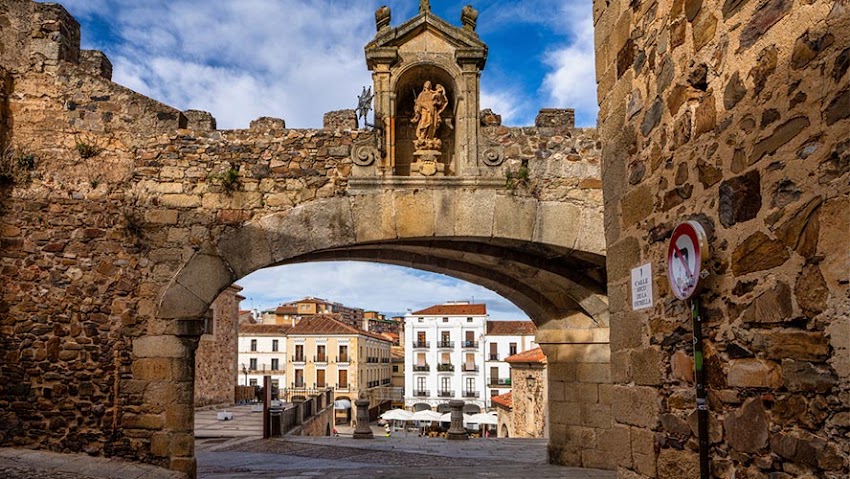
Arco de la Estrella

| Address | C. Arco de la Estrella, S/N, Centro-Casco Antiguo, 10003 Cáceres |
|---|
| Maps | Click here |
|---|
| Website | Click here |
|---|
| Opening Hours | Monday: Open 24 hours
Tuesday: Open 24 hours
Wednesday: Open 24 hours
Thursday: Open 24 hours
Friday: Open 24 hours
Saturday: Open 24 hours
Sunday: Open 24 hours |
|---|
| Phone | 927 25 57 65 |
|---|
Amol Fish★★★★☆
Damn fine entry to the old city.
Габриела Иванова★★★★★
One of the most beautiful old cities 🫶 must visit.
Juliana C M★★★★★
Beautiful arch in Cárceres
Henrik Olsson★★★★★
Game of Thrones film site
Nilton Cáceres★★★★★
An amazing place to visit in Cáceres. The air around is magic, old, medieval.
Baluarte de los Pozos

| Address | Bo. de San Antonio, 13, Centro-Casco Antiguo, 10003 Cáceres |
|---|
| Maps | Click here |
|---|
| Website | Click here |
|---|
| Opening Hours | Monday: Closed
Tuesday: 10:00 AM – 2:00 PM, 4:30 – 7:30 PM
Wednesday: 10:00 AM – 2:00 PM, 4:30 – 7:30 PM
Thursday: 10:00 AM – 2:00 PM, 4:30 – 7:30 PM
Friday: 10:00 AM – 2:00 PM, 4:30 – 7:30 PM
Saturday: 10:00 AM – 2:00 PM, 4:30 – 7:30 PM
Sunday: 10:00 AM – 2:00 PM, 4:30 – 7:30 PM |
|---|
| Phone | 927 22 60 44 |
|---|
Grega Vidmar★★★★★
Nice. It's cheaper if you buy entrance for both towers for just 3€.
Tim de Vries★★★★☆
Not a must-see, but gives a nice and different view from the old city. Cool collection of maquettes of palaces and buildings in Cáceres. Has a combination ticket with the tower at the city square.
Thomas J★★★★★
Scenic part of the old town of Cáceres
Reuben Athaide★★★★★
Woethwhile visit for the history, picturesque view but dont try driving up in a bi car 🙂 park at the foot of the hill and walk!
Lyn Mendoza★★★★☆
Learned more about Caceres’ history and the city walls made by the christians, romans, and jews.
Casa de los Caballos

| Address | C. Rincón de la Monja, 25, Centro-Casco Antiguo, 10003 Cáceres |
|---|
| Maps | Click here |
|---|
| Website | Click here |
|---|
| Opening Hours | Monday: Closed
Tuesday: 9:30 AM – 2:30 PM, 4:00 – 8:00 PM
Wednesday: 9:30 AM – 2:30 PM, 4:00 – 8:00 PM
Thursday: 9:30 AM – 2:30 PM, 4:00 – 8:00 PM
Friday: 9:30 AM – 2:30 PM, 4:00 – 8:00 PM
Saturday: 10:00 AM – 2:30 PM, 4:00 – 8:00 PM
Sunday: 10:00 AM – 3:00 PM |
|---|
| Phone | 927 01 08 77 |
|---|
노지명★★★★★
You can see a small arch as you go up and down the stairs.
ANA GARCÍA★★★★★
A small museum with interesting pieces in a prime location.
We took a guided tour that was well worth it.
Jose Luis Romero★★★★★
It currently houses the Cáceres museum, a renovated building where various workshops and activities take place.
Ladelamanofurada★★★★☆
The House of Horses (16th century), located on Rincón de la Monja Street in Cáceres (Extremadura), was originally the stables of the Palace of the Weather Vanes, also known as the House of the Cisterns (15th-16th centuries). Both buildings now comprise the Museum of Cáceres, which has housed archaeological, ethnographic, and fine arts collections since 1933. They are connected by an arched walkway. The Fine Arts section of the Museum of Cáceres is located here. Works by Diego Copín de Holanda, El Greco, Maarten de Vos, Luis de Morales, Emilio Sala Francés, and José Alcázar Tejedor are among those featured.
Consolación Galea★★★★★
This building houses two of the finest rooms in the Museum of Cáceres. Room 17, in particular, displays sacred art and works from the 13th to the 19th centuries, including El Greco's Christ the Savior, José Alcázar Tejedor's Lair, Emilio Sala's María Picón and Pardiñas with a White Hood, and Lucas Jordan's Saint Andrew, among others. Its vaulted ceiling, remarkable for its shape and excellent state of preservation, makes the room's surroundings, along with its artworks, well worth a visit.
Arco de Santa Ana

| Address | C. Adarve de Sta. Ana, 1, Centro-Casco Antiguo, 10003 Cáceres |
|---|
| Maps | Click here |
|---|
| Website | Click here |
|---|
| Opening Hours | Monday: Open 24 hours
Tuesday: Open 24 hours
Wednesday: Open 24 hours
Thursday: Open 24 hours
Friday: Open 24 hours
Saturday: Open 24 hours
Sunday: Open 24 hours |
|---|
| Phone | 927 62 53 13 |
|---|
Kristie Kupci★★★★★
very nice!
Mysterious Field★★★★★
Fantastic!!!
juanma★★★★☆
The Santa Arch has gradually emerged in the walls of Cáceres. Located at a crossroads, crowned by a statue of the Virgin Mary, it is well worth a visit.
Today it is a relatively uncrowded gate, but more practical than many realize, and possesses a beauty that few truly appreciate.
Ladelamanofurada★★★★☆
The Arch of Santa Ana (1758), located between Adarve del Padre Rosalío and Adarve de Santa Ana streets, number 1, in Cáceres (Extremadura), provides access to Postigo Street and Publio Hurtado Square. This postigo, or minor gate, is a secondary (easily defended) entrance of Muslim origin in the city walls of Cáceres. It was the only access point on the western side during the Muslim period, as the Roman gate that must have existed somewhere in the Forum of the Balbi may have been walled up at that time. In 1758, it was renovated by widening it, becoming the widest gate with three sections of brick vaulting. Above the segmental arch, inside the walled enclosure, is a shell-shaped niche containing a stone image of Saint Anne (grandmother) sheltering the Virgin Mary (mother) holding the Child Jesus (son). A modern image of Saint Anne, the Virgin Mary, and the Child Jesus (1963), a work by the sculptor José Manuel Rodríguez Vázquez 'Pepe de Arganda' (Santiago de Compostela, 1935). Inside the gate, we see a series of brick barrel vaults—an architectural characteristic of Cáceres. The Santa Ana postern gate had an Arab barbican tower—the Postigo Tower (12th century), with a square floor plan, Roman ashlars at the base, and an adobe upper structure—which protected it from potential attacks. Today, it is embedded among the surrounding houses, and only its upper portion is visible. The postern gate and tower were joined by a spur, which was later incorporated into a house; the entire structure is visible from a bird's-eye view.
José Ignacio Albalá★★★★★
The Arch of Santa Ana is one of the gateways to the walled city of Cáceres, Spain.
Since Muslim times, it has been a minor passageway within the city walls. In 1758, it was renovated and widened to facilitate passage into the city.
In the center of the arch is a niche containing a stone image of Saint Anne holding the infant Jesus in her lap.
This gate was one of the access points opened out of necessity between the main gates of the wall.
Its current appearance dates from the 18th century. The outer arch, facing the wall-walk, is topped by a niche containing a modern image of Saint Anne with the Virgin and Child. The interior features a series of beautiful brick vaults, characteristic of Cáceres.
Palacio de Carvajal

| Address | C. Amargura, 1, Centro-Casco Antiguo, 10003 Cáceres |
|---|
| Maps | Click here |
|---|
| Website | Click here |
|---|
| Opening Hours | Monday: 8:00 AM – 8:45 PM
Tuesday: 8:00 AM – 8:45 PM
Wednesday: 8:00 AM – 8:45 PM
Thursday: 8:00 AM – 8:45 PM
Friday: 8:00 AM – 8:45 PM
Saturday: 10:00 AM – 1:45 PM, 5:00 – 7:45 PM
Sunday: 10:00 AM – 1:45 PM |
|---|
| Phone | 927 25 55 97 |
|---|
Nanita★★★★★
If only every tourist office has as beautiful a setting as the one in Cacéres! Explore the courtyard and inner garden where you can catch some shade before entering the tourist information office located here. The staff is extremely helpful, informing you what is open and closed (worth considering that there are midday breaks often for several hours so people can escape the heat). Worth stopping in for a visit!
Richard Leathem★★★★★
FREE. Apart from the courtyard, garden and tourist office, it has a model of the old town which is useful. Tourist office staff are helpful.
PS. Beware the Caceres museum is closed and in reconstruction
Daniel Gent★★★★★
Very friendly staff and a nice first floor & garden to walk around
darius savolskis★★★★★
As for the tourism office there is probably no better location as this magnificent palace
R N★★★★★
5 stars just for the amazing Nativity Scene for Christmas! Best tourist office ever!!
Palacio de los Cáceres-Ovando

| Address | Pl. San Pablo, 1, Centro-Casco Antiguo, 10003 Cáceres |
|---|
| Maps | Click here |
|---|
| Website | Click here |
|---|
| Opening Hours | — |
|---|
| Phone | — |
|---|
노지명★★★★★
This is the Palace of Cáceres-Obando. The night view is especially stunning.
Kike★★★★★
A well-proportioned building, its most striking feature is its tower, much taller than those of the other palaces in the Monumental City. This is because when Queen Isabella I of Castile ordered the truncating of the towers in Cáceres, she made an exception for this one, which was then under construction by order of Captain Diego de Ovando, a vassal and member of her Royal Council. She allowed him to build the palace and tower as he wished.
It was built on the ruins of the old Muslim alcázar, and construction was completed in the early 16th century. Its façade combines coats of arms of the Ovando and Mogollón families, framed by an alfiz (a rectangular molding).
In the entrance hall, we find arquebuses, muskets, blunderbusses, precision weapons, and torches.
We also find a bench with "something hanging," which is none other than a "knight's halter." The knight, equipped with his armor, was unable to mount his horse without help, so this peculiar method was used to help them get on, and once on, they were given the lance and shield (which are right there where the bench is) so that they could go to the fight.
Rey Lobo★★★★★
Another of the countless palaces in the architectural ensemble of Cáceres. It now houses a military museum with a large collection of military artifacts.
Jorge Hedges★★★★★
The Cáceres-Ovando Palace is spectacular. Beautifully presented, and the guides are extremely well-prepared for the tours. A visit to this magnificent palace is a must!
Alexia MC★★★☆☆
No sé si era por la situación de ahora pero solo pudimos pasar por un patio donde estaban poniendo el Belén y un pequeño jardín al que tampoco se podía casi acceder.
Toledo-Moctezuma Palace

| Address | Pl. Conde de Canilleros, 1, Centro-Casco Antiguo, 10003 Cáceres |
|---|
| Maps | Click here |
|---|
| Website | Click here |
|---|
| Opening Hours | — |
|---|
| Phone | — |
|---|
Paul Martinez★★★★★
I am a descendent as well and one day soon, hope to visit the Palacio
Nuria GD★★★★☆
The Plaza del Conde de Canilleros is one of the most pleasant squares in the old town, and the Toledo-Moctezuma Palace contributes greatly to that feeling.
It's a peaceful, balanced, and less crowded place, ideal for pausing and enjoying the atmosphere at a leisurely pace, away from the more saturated areas.
Maria Rodriguez (Merimorena)★★★★★
I thought it was super beautiful and clean, and it has a lot of interesting history worth reading. There's an exhibition now called "Written Memory," and it's definitely worth a visit.
Maria Angeles Arroyo★★★★★
Juan de Toledo Moctezuma (grandson of Isabel de Moctezuma and Captain Cano) and his wife Mariana de Carvajal built it at the end of the 16th century. Its coat of arms blends Spanish heraldic symbols with Aztec lineage symbols. Inside is the Mexican Room, which contains frescoes with portraits of Mexican emperors and leaders. It currently houses the Provincial Historical Archive of Cáceres.
Jquimmauri★★★★☆
Current headquarters of the provincial historical archive. A small part can be visited, with a porticoed courtyard and an exhibition hall. Free admission.
Arco del Cristo

| Address | C. Adarve del Cristo, 17a, Centro-Casco Antiguo, 10003 Cáceres |
|---|
| Maps | Click here |
|---|
| Website | Click here |
|---|
| Opening Hours | Monday: Open 24 hours
Tuesday: Open 24 hours
Wednesday: Open 24 hours
Thursday: Open 24 hours
Friday: Open 24 hours
Saturday: Open 24 hours
Sunday: Open 24 hours |
|---|
| Phone | — |
|---|
Nanita★★★★☆
One of the four original Roman gates / entrances to Cáceres, Arco del Cristo is extremely well maintained.
Ladelamanofurada★★★★☆
The Arch of Christ, also known as the River Gate or Council Gate (1st-3rd centuries AD), is located between Cuesta del Marqués and Fuente del Concejo streets in Cáceres, Extremadura. Of Roman origin, it is the oldest preserved gate in the monumental city of Cáceres, situated on the eastern flank of the city wall. Large Roman ashlars form two large semicircular arches. Inside the gate, a covered niche houses a painting of Christ, dating from the early 19th century. Attached to the gate is the River Tower. It provides access from the Old Jewish Quarter to the banks of the Marco River, the only local river. It seems that a branch of the 'Silver Route' entered Norba Caesarina (Cáceres) - a colony of Roman citizens founded in 34 BC by the proconsul Gaius Norbanus Flaccus - this route led to Augusta Emerita (Mérida), after descending to the Marco River and joining the road that comes out through the Coria Gate.
Juan José Barraso★★★★☆
One of the gateways to the historic center of Cáceres.
The Puerta del Río (River Gate) is the only original Roman gate that remains of the four that originally existed.
It was built in the 1st century with large ashlars and consists of two semicircular arches.
On its exterior, the arch provides access to the Ribera del Marco (Marco Riverbank), hence the name Puerta del Río (River Gate). Attached to the gate is one of the city's defensive towers, known as the Torre del Río (River Tower).
Currently, it is known as the Arco del Cristo (Arch of Christ), due to the image of the Crucified Christ in the niche on its interior, dating from the early 19th century.
Pepe Bris Garcia★★★★★
A marvel at the end of Calle Caleros
Alberto Hernando★★★★★
Next to the Jewish quarter and one of the sections with remains of the Almohad wall (restored), it is the only arch preserved from the Roman era....
Calerizo de Cáceres

| Address | 10003 Cáceres, Cáceres |
|---|
| Maps | Click here |
|---|
| Website | Click here |
|---|
| Opening Hours | Monday: Open 24 hours
Tuesday: Open 24 hours
Wednesday: Open 24 hours
Thursday: Open 24 hours
Friday: Open 24 hours
Saturday: Open 24 hours
Sunday: Open 24 hours |
|---|
| Phone | — |
|---|
Rafael Ramos★★★★☆
Perfect for a stroll and a relaxing read... A magnificent spot
Esteban Perez Borrego★★★★★
Nice place to understand what the subsoil of Cáceres is like.
Cathedral of Santa Maria

| Address | Pl. Sta. María, 3, Centro-Casco Antiguo, 10003 Cáceres |
|---|
| Maps | Click here |
|---|
| Website | Click here |
|---|
| Opening Hours | Monday: 10:00 AM – 8:00 PM
Tuesday: 10:00 AM – 8:00 PM
Wednesday: 10:00 AM – 8:00 PM
Thursday: 10:00 AM – 8:00 PM
Friday: 10:00 AM – 8:00 PM
Saturday: 10:00 AM – 8:00 PM
Sunday: 10:00 AM – 12:30 PM, 2:00 – 6:30 PM |
|---|
| Phone | 927 21 53 13 |
|---|
Flo★★★★☆
The interiors of this church was quite interesting. But what made it worth paying the entry fee was the view from the tower. Absolutely stunning view on the old town.
jose lourenco★★★★☆
The cathedral was smaller than we thought. It has features that are very similar to those in Salamanca. The tower ‘views’ are underwhelming since they have installed iron gates that impede you from reaching the wall.
Jesper Carvalho Andersen★★★★☆
This beautiful 15th century, gothic Santa Maria Co-Cathedral in Caceres has an impressive Renaissance altarpiece in cedar wood by Roque Balduque.
José Santos★☆☆☆☆
First Catholic church that I would need to pay to be able to enter.
Most cities are now making even museums entry free to attract more tourists.
This looks more of a local church, for local people (that have pesetas)
David OMalley★★★★★
Small cathedral that punches above its weight. Wonderful Gothic vaults and a unique alter piece. The climb up the tower is worth it for the great views over Caceres. It also features a nice museum with an impressive array of pieces of religious art. Keep an eye on the floor, which contains many grave markers of past church benefactors.
Palacio de Mayoralgo

| Address | Pl. Sta. María, 8, Centro-Casco Antiguo, 10003 Cáceres |
|---|
| Maps | Click here |
|---|
| Website | Click here |
|---|
| Opening Hours | — |
|---|
| Phone | — |
|---|
HERBY STEVAN★★★★★
Mayoralgo Palace (14th-16th century), in Santa María Square, in Cáceres (Extremadura). A unique building constructed with various types of stone.
Ladelamanofurada★★★★☆
Palacio del Mayoralgo (ss. XIV-XVI), en la plaza de Santa María, en Cáceres (Extremadura). Unido por medio de paso elevado con la Torre de los Púlpitos -zona de la muralla-, cerca de la Puerta la Estrella. El linaje se configura a partir de don Blasco Monio (s. XIV), latifundista del S. de la provincia cacereña; su hijo primogénito don Blasco Muñoz funda un mayoralgu -voz asturlleonesa que se define como mayorazgo, no olvidemos que éste es el dominio de la tierra extremeña- en el N. de la Sierra de San Pedro. A sus descendientes se les llamó señores de la Torre del Mayoralgo o Torre de Velasco, por lo que algunos portaron 'Mayoralgo' como apellido. Palacio gótico y renacentista. Fachada principal simétrica, sin torres flanqueantes, gran puerta de arco de medio punto bajo escudo -no original, pues éste fue destruído en la 'guerra civil española' -bombardeo republicano de castigo del 23 de julio de 1937: 5 Túpolev soviéticos, al mando del teniente coronel Jaume Mata Romeu, arrojaron 18 bombas sobre el casco histórico, muriendo 35 personas, destrozando numerosos palacios-, del linaje Blázquez-Mayoralgo- entre dos ventanales geminados. Fachada lateral a la calle del Arco de la Estrella, con puerta gótica (s. XIV).
Patitas Ruteras★★★★★
It's right above the star arch, you walk there; it's more beautiful at night, you can see part of the old town
AM PP★★★★☆
Manor house in the old town, very well preserved.
elaisiem★★★★★
A palace dating from the late 15th and early 16th centuries, with a 14th-century Mudéjar courtyard. The façade incorporates Gothic and Renaissance elements. It features a main entrance with a semicircular arch and voussoirs. Above it, on either side, are the coats of arms of Blázquez (Mayoralgo), depicting half an eagle and a tower.
An alfiz (a rectangular frame around the façade) divides the façade into three sections. In the central section is a large Renaissance coat of arms of Mayoralgo, surmounted by a helmet from which serpentine stems emerge, ending in figures of cherubs and dragons. At the base is an inscription: “May you, Lord, be for us a tower of strength, and our youth will be renewed like that of the eagle,” referring to the coat of arms.
On either side, framed entirely by the alfiz, are two twin windows with semicircular arches.
On the right-hand side of the palace façade, along the street of the Arco de la Estrella (Star Arch), we also find a pointed archway, dating from the 16th century, which bears a very old coat of arms of Mayoralgo, from the time of Alfonso XI. Another coat of arms, belonging to Catalina Enríquez, can be found on the corner facing the plaza.
As additional information: Mayorazgo (or entailed estate) is an institution of ancient Castilian law that allowed a group of properties to be linked together in such a way that this link could never be broken. The properties thus linked passed to the heir, usually the eldest son, so that the bulk of a family's wealth was not dispersed, but could only increase.
It is worth noting that this palace is now an institutional headquarters of Caja Extremadura (Liberbank), and numerous Roman-era remains were discovered during its renovations.
Palacio de Galarza

| Address | Calle Gral. Ezponda, 14, Centro-Casco Antiguo, 10003 Cáceres |
|---|
| Maps | Click here |
|---|
| Website | Click here |
|---|
| Opening Hours | Monday: 9:00 AM – 1:00 PM
Tuesday: 9:00 AM – 1:00 PM
Wednesday: 9:00 AM – 1:00 PM
Thursday: 9:00 AM – 1:00 PM
Friday: 9:00 AM – 1:00 PM
Saturday: Closed
Sunday: Closed |
|---|
| Phone | 927 62 73 38 |
|---|
Ladelamanofurada★★★★☆
The Galarza Palace and Tower (15th century), also known as the House of Tricks or the Church House, is located on the corner of General Ezponda and Santo Domingo streets, near the Plaza Mayor of Cáceres (Extremadura), next to the Isla and Marqués de Camarena palaces, the Church of Santo Domingo, and the Plaza de la Concepción. It was commissioned by the Sephardic banker and last rabbi of Cáceres, Sergas Cohen, who built a house for his family outside the city walls—in the New Jewish Quarter. Due to the expulsion decree of the Catholic Monarchs (1492), he was forced to sell it at a loss, and it was purchased by Diego González Messía, who was married to María de Ovando. At the beginning of the 15th century... In the 16th century, his grandson, Don Diego Messía de Ovando—Lord of Loriana and steward to Queen Anne of Austria—renovated the palace. It then passed into the hands of the Velázquez Dávila family, who sold it in 1595 to the Bishop of Coria, the enlightened scholar from Cuenca, Don Pedro García de Galarza (1538-1604)—advisor to Philip II—who undertook the Plateresque renovation. Today, we see a tall, truncated 15th-century tower with a palace dating from the 16th and 17th centuries. Interestingly, Don Pedro commissioned the construction of a 200-meter-long underground passageway connecting his family palace—full of secret rooms and passageways dating back to the time of Mr. Sergas—with the Bishop's Palace, thus linking his home with his work. Owned by the Diocese of Coria-Cáceres by sale (1996) from the congregation of the Apostolic Ladies of the Heart of Jesus (1924), who had a girls' school here since the 1960s.
José Ignacio Albalá★★★★★
The Galarza Palace and Tower, also known as the "House of Tricks" or "Church House," has a history dating back to the 15th century, when a Jewish banker named Cohen built a house for his family outside the walled city. However, the Catholic Monarchs' decree expelling the Jews from the Iberian Peninsula forced him to sell his house, which was then purchased by the Dávila family, a noble family from Cáceres.
In the 16th century, the house changed hands again, this time being acquired by Bishop Galarza (whose surname the building bore) and given to his family.
Vanessa Santano - Su Secretaria Virtual★★★★☆
Very well preserved, you can see its balconies and stone details, wonderful!
Paco rodriguez★★★★☆
A very well-preserved place and well worth a visit
Tips for Exploring the Old Town
To make the most of your visit to this historic quarter, a little local knowledge goes a long way. The old town is a maze by design, intended to confuse invaders centuries ago, but with the right approach, you can navigate it like a seasoned traveler and uncover its hidden nuances.
- Wear Sturdy, Grippy Footwear: The streets are famously paved with smooth, rounded stones that have been polished by centuries of foot traffic. They can be incredibly slippery, especially after a light rain or in the early morning dew. Leave the dress shoes at the hotel and opt for rubber-soled sneakers or walking boots.
- Time Your Visit for Golden Hour: The stone of Cáceres changes color dramatically with the sun. Visit in the late afternoon to see the facades glow a warm gold, then stay until dusk. As the sun sets, the floodlights illuminate the towers and gargoyles, creating a romantic, almost theatrical atmosphere that is perfect for photography.
- Look Up and Behind You: The most spectacular architectural details are often above eye level. Look for the distinctive "matacanes" (defensive balconies), intricate gargoyles, and the massive nests of the white storks that have made the towers their home for generations.
- Visit on a Weekday Morning: While weekends bring a lively buzz, the narrow alleys can feel crowded with tour groups. Visiting on a Tuesday or Wednesday morning often grants you the solitude needed to hear the echo of your footsteps and appreciate the medieval silence.
- Seek Out the Courtyards: Many of the grand palaces are still private residences or government buildings, but their doors are often open during business hours. Don’t be afraid to peek inside the entryways; you will often be rewarded with views of lush, cool interior patios filled with orange trees and ancient wells.
Exploring Cáceres is a masterclass in Spanish history, offering an authenticity that is increasingly rare in the modern world. The lack of mass commercialization within the walls allows the architecture to speak for itself, telling stories of conquest, wealth, and nobility.
As you leave through the Arco de la Estrella and glance back at the ramparts, the skyline of towers and storks remains etched in your memory. It is a place that rewards the curious traveler, offering a deep connection to the past that lingers long after you have returned home.
Freya Belle is a content writer and travel journalist specializing in European destinations. With experience exploring over 30 European countries, she focuses on providing in-depth guides to authentic cuisine, historical culture, and hidden gems often overlooked by mainstream tourists. Her writing helps travelers experience Europe like a local.